Foreign Investor Legal Support for Business Setup in Thailand
Starting a business in Thailand is rarely just a registration exercise.
Before choosing shareholders, signing documents or investing capital, it is worth understanding the legal and practical considerations that may affect the business long after registration is complete.
Image

TILA LEGAL is a private law firm in Bangkok assisting foreign SME owners and investors with company setup, legal structuring, documentation, and compliance in Thailand.
We assist clients in understanding legal and practical considerations before committing capital, signing documents, or implementing a business structure.
Image
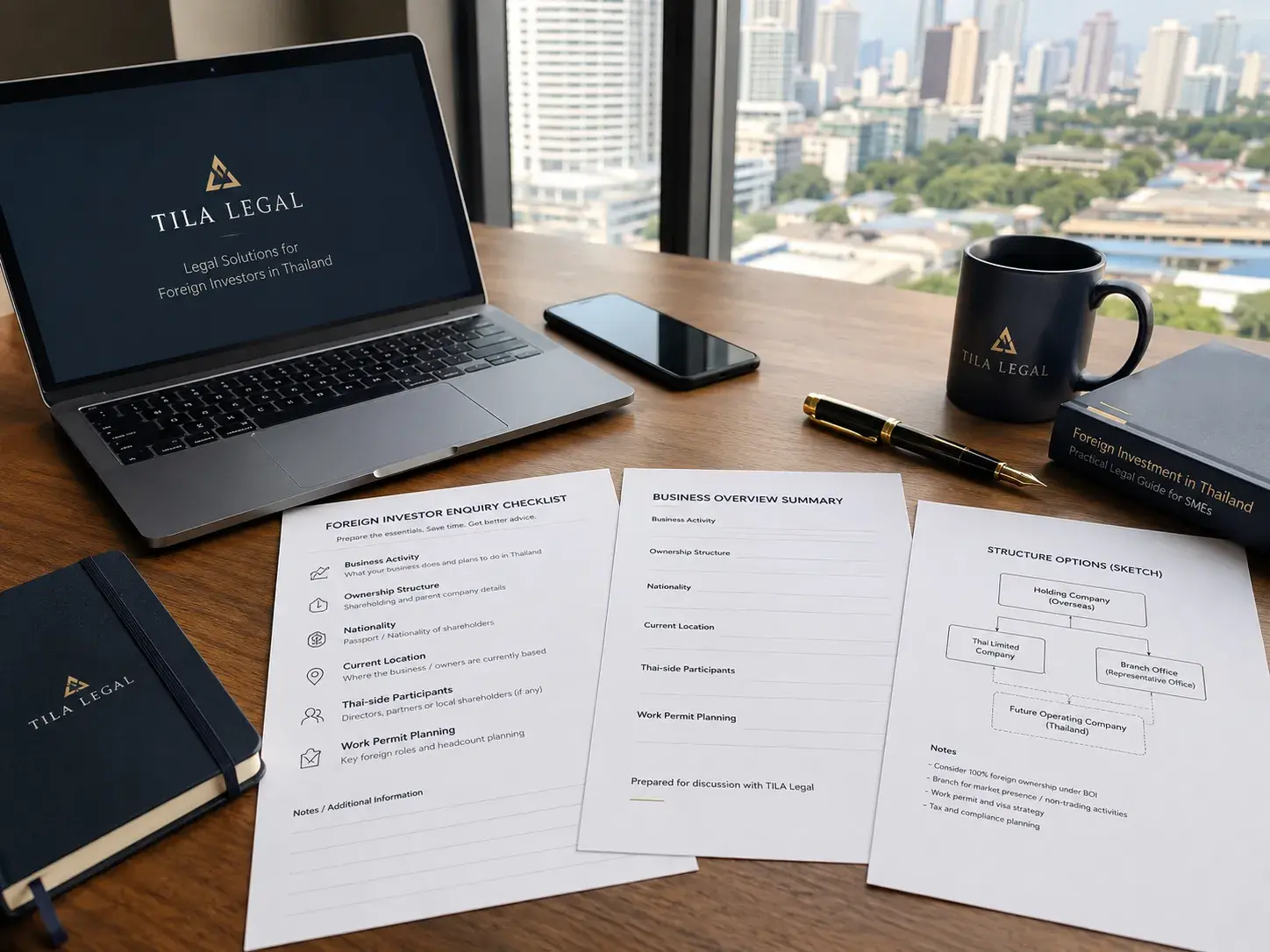
One of the more interesting aspects of advising foreign business owners in Thailand is that the conversation is rarely about company registration, even when registration is the reason someone initially reaches out to our office.
By the time a prospective client contacts us, the registration process is often the least complicated part of the project. The business idea already exists, capital has usually been set aside, and discussions have often taken place with a spouse, a business partner or a potential investor. In some cases, premises have been identified; in others, commercial negotiations are already underway.
The concern behind the enquiry is usually more substantial than the filing process itself. A person considering a business in Thailand is trying to understand whether the decisions being made now will still make sense once money has been invested, documents have been signed and the business begins operating in practice. That concern is entirely reasonable. Building a business in a new country involves unfamiliar rules, local practices and commercial expectations that may differ considerably from those in the investor's home jurisdiction.
It is not unusual for someone to arrive at our office having already received several opinions on the same issue. A friend may have suggested one approach, a business contact may recommend another, and online forums often provide confident answers to matters that require a more careful review of the facts. The result is that business owners sometimes have more information than ever before, yet less confidence about which information should actually guide their decision.
The advice may be well-intentioned, and in some cases it may even be correct for the situation in which it was originally given. The problem is that business decisions rarely exist in isolation. A structure that makes sense for a small consulting practice may be unsuitable for a hospitality venture. An arrangement that works comfortably between family members may create avoidable complications when outside investors become involved. A solution that appears practical at the beginning may become difficult to adjust once the business has grown, staff have been hired or commercial commitments have been made.
Over the years, we have found that conversations about shareholders, documentation and implementation become much more productive once there is a clear understanding of what the business is expected to become. A business intended to remain small and owner-operated will usually be approached differently from one expected to take on investors, expand to multiple locations or become a long-term family asset. Without that context, discussions about ownership, control and structure can become little more than educated guesses.
This is why planning before paperwork is often the more valuable conversation. Registration matters, documentation matters and compliance matters, but those steps are easier to manage when the underlying commercial and legal decisions have been properly considered from the outset. The more difficult situations we see are not usually caused by a company being registered incorrectly. They tend to arise when assumptions made at the planning stage were never clearly examined before the business moved forward.
Before committing capital, signing documents or choosing a structure, it is worth taking time to understand not only what needs to be done, but why it is being done and how those decisions may affect the business several years from now. That conversation may feel slower at the beginning, but it often gives business owners a clearer basis for proceeding with confidence. For many foreign SME owners considering Thailand, that is where the most useful legal guidance begins.
Image
Before Proceeding, Understand the Bigger Picture
Image

A business structure may appear suitable at the beginning. The more important question is whether it will continue to support the business as ownership, operations and commercial objectives evolve.
The Five Decisions That Deserve Careful Consideration Before Moving Forward
By the time a prospective client reaches this stage of the conversation, the discussion is no longer really about registration. Most business owners have already accepted that a company can be incorporated and documents can be prepared. The more important question is whether the decisions being made before implementation are likely to support the business over the long term.
Over the years, we have found that the most productive conversations tend to focus on a handful of practical issues. The answers vary from one project to another, but the questions themselves are remarkably consistent. They usually relate to the nature of the business, ownership, control, operational involvement and long-term objectives.
What follows is not intended as a checklist. Rather, these are the areas that frequently shape the direction of the discussion and influence many of the decisions that come afterwards.
1. What Is The Business Expected To Do?
Conversations often become easier once there is a clear understanding of what the business is actually expected to become. A consulting business, a hospitality venture, a trading operation and a technology company may all appear similar at the planning stage. In practice, they can raise very different commercial and operational considerations.
A common theme among prospective clients is the assumption that structure comes first and business activity comes second. Our experience has generally been the opposite. Once the business model is properly understood, many questions relating to implementation become easier to evaluate because they are being considered within the context of a defined commercial objective.
2. Who Will Own The Business?
Questions about ownership tend to arise very early in the planning process, particularly where more than one individual is involved. Ownership is naturally important. It reflects investment, commercial expectations and future participation in the business.
What is sometimes overlooked is that ownership decisions often continue to affect the business many years after registration is complete. Additional investors may join. Family circumstances may change. Business objectives may evolve. A structure that appears entirely reasonable at the beginning may eventually need to accommodate circumstances that were not originally anticipated.
3. Who Will Control The Business?
One of the more interesting aspects of advising business owners is how frequently ownership and control become part of the same conversation. Many people understandably assume that the two concepts are identical. In practice, they are not always the same.
Questions relating to decision-making authority, management responsibility and future flexibility often become increasingly important as a business grows. These issues may not attract much attention when everyone involved shares the same expectations. They tend to become more relevant when circumstances change or commercial priorities begin to diverge.
4. What Role Will The Foreign Investor Play?
It is not unusual to see business owners focus heavily on structure while spending relatively little time discussing how the business will operate on a day-to-day basis. Yet practical involvement is often one of the factors that influences planning decisions from the outset.
Some individuals intend to play an active management role. Others expect to focus on investment and strategic oversight. Understanding how the business is expected to function in practice often provides useful context for decisions that might otherwise be considered in isolation.
5. Where Is The Business Expected To Be In Five Years?
A common theme among successful business owners is that they rarely plan exclusively for the present. While nobody can predict the future with certainty, it is often helpful to consider what the business may look like if things go well.
Will additional locations be opened? Will outside investors be introduced? Will the business remain owner-operated or evolve into something larger? These are not questions that require perfect answers. They simply help create a framework within which present-day decisions can be evaluated more effectively.
Many implementation issues become easier to manage when there is a clear understanding of the direction in which the business is intended to move.
Image
Common Themes We Encounter When Advising Foreign Business Owners
One of the advantages of speaking with business owners at the planning stage is that certain patterns become easier to recognise over time. While every project is different, many of the challenges that eventually create frustration, delay or unnecessary expense tend to originate from decisions made long before the business begins operating.
The purpose of discussing these themes is not to suggest that every project is high risk or unusually complicated. In many cases, the underlying issue is simply that attention was focused on one part of the project while another area received far less consideration than it deserved.
A common example involves business owners who devote considerable time to discussing registration procedures while spending relatively little time examining the assumptions that sit behind the proposed structure. Registration is visible. It can be researched online and compared between providers. Questions relating to ownership, control and long-term objectives are often less straightforward, which sometimes causes them to be postponed until later.
Another theme that arises from time to time is the assumption that a structure which worked well for one person will automatically work well for another. The reasoning is understandable. Business owners naturally seek practical examples and real-world experience when evaluating an unfamiliar market. The difficulty is that no two businesses are entirely alike.
A hospitality business operating in a resort environment may face a very different set of commercial realities from a consulting firm, a trading operation or a technology company. Advice that was entirely appropriate for one project may offer limited value when applied to another without understanding the surrounding circumstances.
Questions about ownership and control also tend to become more significant as businesses mature. During the early stages of a project, participants are usually aligned around a shared objective. Expectations are clear and enthusiasm is high. As the business develops, however, new opportunities, commercial pressures and strategic decisions may emerge. Arrangements that once appeared perfectly adequate can begin to feel less certain when circumstances evolve.
We have also observed that business owners frequently underestimate how quickly commercial decisions accumulate. A lease may be signed. Equipment may be purchased. Staff may be recruited. Marketing commitments may be made. None of these decisions are inherently problematic. The challenge is that each additional commitment can make future changes more expensive, more disruptive or more time-consuming than they would have been at the beginning of the process.
This is one of the reasons why planning conversations are often most valuable before implementation begins. At that stage, the discussion can focus on objectives, assumptions and alternatives without the pressure that accompanies an active business operation.
In our experience, the most successful projects are not necessarily those that move the fastest. They are often the projects where the owners take the time to understand the implications of important decisions before they become difficult to revisit.
The goal is rarely perfection. Business inevitably involves uncertainty and no structure can eliminate every future challenge. What good planning can do is improve decision-making, reduce avoidable surprises and provide a stronger foundation for the business as it grows.
RELATED RESOURCES
Can a Foreigner Open a Company in Thailand?
Do I Need a Thai Shareholder?
Ownership and Control Considerations in Thailand
Work Permit Planning After Company Setup
Thailand Business Legal Questions Answered
Before choosing shareholders, signing agreements or committing capital, it is often worth stepping back and considering the broader picture.
Provide a brief overview of your proposed business, ownership plans and objectives. Our legal team can help identify legal and practical considerations that may be relevant before implementation begins.


