Short Answer
Business Planning Guides is TILA LEGAL's decision library for foreign SME owners who are considering a company, business structure, shareholder arrangement, or work permit plan in Thailand. The purpose is not to publish general articles. It is to help business owners understand the decisions that should be considered before documents are signed, ownership percentages are agreed, funds are committed, or implementation begins.
Image

Practical Explanation
Business owners rarely think in legal categories at the beginning. They usually think in practical questions: Can I open a company? Do I need a Thai shareholder? Can I own the business? Can I work in the company? Should I use my spouse, partner, friend or investor as a shareholder? Should I consider BOI? Is company registration enough, or should work permit planning be considered first?
These questions are not abstract. They normally appear when a foreign business owner is close to making a real decision. Capital may already have been set aside. A lease may be under discussion. A Thai partner may already be involved. A business name may already have been chosen. In some cases, documents may already be circulating for signature. At that point, the business owner does not need a long article. He needs a clearer way to decide what should be reviewed before the project moves forward.
This is why the Business Planning Guides should function as a decision library rather than a blog, news section, or article archive. The purpose is not to chase traffic with broad legal commentary. The purpose is to organise the most common decision points foreign SME owners face when preparing to open, structure, or operate a business in Thailand.
In many cases, the question is not whether a Thai company can be formed. A company can often be prepared as a technical process. The more valuable question is whether the proposed structure will still make sense after the business begins operating, hires staff, signs contracts, applies for tax registrations, considers work permit requirements, or brings in additional investors.
Ownership, control, compliance, and work permit planning are often connected. A foreign business owner may focus on shareholding percentages, while the more practical question may be who will make decisions, who will sign for the company, who will contribute capital, who will work in the business, and whether the business activity raises any foreign ownership or licensing considerations. These issues are easier to discuss before the structure is implemented than after assumptions have been built into signed documents.
For owner-managed SMEs, timing matters. A restaurant, fitness gym, car wash business, consulting company, trading operation, import and export business, or small hospitality venture may all appear straightforward at the idea stage. The relevant planning issues may become clearer only when the intended activity, location, shareholder arrangement, working role, revenue model, and future objectives are considered together.
The guides should therefore help readers recognise when a short answer is enough and when their facts should be reviewed. Some readers will simply need orientation. Others will be close to signing documents, transferring funds, agreeing a lease, or asking a Thai person to hold shares. Those readers should understand that a planning conversation before implementation can be more useful than trying to correct a structure later.
TILA's role on this page is not to make every issue sound complicated. The page should convey something more practical: before choosing a structure, it is worth understanding the business activity, ownership position, control arrangements, documentation, work permit planning, and compliance implications. That is the point at which professional support can help the client make a better commercial decision.
Start With the Question Closest to Your Decision
The Business Planning Guides are organised around the decisions foreign SME owners most often need to make before opening or structuring a business in Thailand. Each guide is designed to answer a practical question and help the reader understand what should be considered before moving forward.
1. Start a Business in Thailand Without Avoidable Mistakes
Best for: For readers who want a practical overview before taking first steps.
2. For Foreign SME Owners Opening a Company in Thailand
Best for: For owner-managed businesses considering company setup, structure, and implementation.
3. Can a Foreigner Open a Company in Thailand?
Best for: For readers asking whether company formation is possible and what facts affect the answer.
4. Do I Need a Thai Shareholder?
Best for: For readers deciding whether a Thai-side participant is required or commercially sensible.
5. Can I Get a Work Permit After Company Setup?
Best for: For readers who expect to work in the business after the company is formed.
6. I Am a Foreigner. Can I Open a Company in Thailand?
Best for: For AI-ready search queries and readers seeking a clear starting answer.
7. For Foreign Consultants Setting Up in Thailand
Best for: For consultants, advisers, agencies, and service professionals planning an owner-managed business.
8. For Small Hospitality Businesses in Thailand
Best for: For restaurants, cafes, boutique hospitality projects, and other location-based businesses.
9. For Foreign Investors Who Need Work Permit Planning
Best for: For readers whose company structure is connected to future work authorisation planning.
10. Common Mistakes Foreign SME Owners Make When Starting a Business in Thailand
Best for: For readers who want to understand avoidable planning errors before implementation.
Common Planning Mistakes This Library Helps Readers Avoid
Foreign SME owners do not usually run into difficulty because they asked too many questions at the beginning. Problems more often arise when important assumptions were never examined before implementation. These guides are designed to help readers consider the following issues earlier:
- Choosing a structure before understanding foreign ownership restrictions or activity-specific requirements.
- Signing documents without understanding ownership, control, director authority, and future decision-making.
- Assuming company registration means the business is fully compliant for all practical purposes.
- Ignoring future work permit planning until after the company, lease, staffing, or tax position has already been arranged.
- Using arrangements they do not fully understand, especially where Thai shareholders, informal understandings, or borrowed structures are involved.
What This Means for Foreign SME Owners
For a foreign SME owner, the Business Planning Guides should act as a map of the decisions that usually sit behind company setup in Thailand. The reader may have started with a simple question about company registration, but the practical decision often involves ownership, control, investment, future work roles, commercial commitments, and compliance.
The benefit is decision clarity. A business owner who understands which question applies to his situation can avoid treating registration as the whole answer. He can also recognise which issues should be discussed before asking someone to hold shares, signing company documents, committing to premises, or assuming that he can work in the business after company setup.
This is especially useful for foreign SME owners who already have a Thai spouse, Thai partner, trusted Thai shareholder, or local business contact involved. That relationship may be a practical starting point, but it should still be supported by a structure and documents that reflect the intended business relationship.
When to Speak With TILA
The best time to speak with TILA is before a decision becomes difficult or expensive to revisit. This is especially relevant before:
- Before choosing the initial company structure or shareholding percentages.
- Before asking a Thai spouse, partner, friend, or associate to hold shares.
- Before signing documents that affect ownership, director authority, control, or capital contribution.
- Before transferring investment funds or committing significant resources.
- Before signing a lease, buying equipment, hiring staff, or launching operations.
- Before assuming that company setup will support a future work permit.
- Before deciding whether BOI, a Foreign Business Licence, or another regulatory route is relevant.
- Before changing an existing structure that already involves Thai shareholders, foreign ownership, or a foreign director.
Image
FAQ Section
What is the purpose of the Business Planning Guides?
The Business Planning Guides are intended to help foreign SME owners make better decisions before they open, structure, or implement a business in Thailand. They are not designed as a blog, news feed, or general legal article library. The purpose is more practical: to organise the questions that usually affect real business decisions before money, documents, relationships, and commercial commitments become difficult to change.
A foreign business owner may begin by asking whether a company can be opened in Thailand. That is a sensible question, but it is only the starting point. The better planning questions often involve business activity, ownership, control, Thai shareholder arrangements, director authority, work permit planning, tax registrations, premises, and the way the business is expected to operate in practice.
The guides should help the reader identify which issue is closest to his current decision. A reader who has not yet chosen a structure may need a general planning guide. A reader who already has a Thai partner may need to understand shareholder and control issues. A reader who expects to work in the business may need to consider work permit planning before finalising the company structure.
The guides are not a substitute for advice on a specific set of facts. They are intended to make the first conversation more productive and help the reader understand when professional support should be considered before implementation.
Which guide should I read first if I want to open a company in Thailand?
A foreign SME owner who is still at the early planning stage should usually begin with a guide that explains the broader structure of the decision, rather than jumping directly to a technical question. If the business has not yet chosen shareholders, director authority, premises, work roles, or ownership percentages, the best starting point is usually a planning guide that explains how company setup, ownership, control, and compliance fit together.
After that, the right guide depends on the reader's facts. If the main concern is whether a foreigner can form a company, the reader should start with the foreign company ownership guide. If the issue is Thai shareholding, the Thai shareholder guide is more relevant. If the foreign owner expects to work in the business, the work permit planning guide should be read before assuming that company registration alone is enough.
For consulting, hospitality, restaurants, gyms, trading, import and export, and other owner-managed businesses, the most useful guide is often the one that matches the business model. A structure that appears sensible for a small consultancy may not be the same structure that should be considered for a location-based hospitality business.
If the reader is already in Thailand and close to signing documents, agreeing shareholding percentages, or committing funds, reading the guides should be treated as preparation for a focused discussion with TILA rather than a final decision by itself.
Should I decide the Thai shareholder arrangement before speaking with TILA?
It is better not to treat the Thai shareholder arrangement as a finished decision before the structure has been reviewed. A foreign business owner may already have a Thai spouse, Thai partner, Thai friend, investor, or trusted person involved. That can be a practical starting point, but it should not be reduced to a name on the shareholder list without considering the legal and commercial implications.
Questions about Thai shareholders are usually connected to ownership, control, capital contribution, voting, director authority, business risk, future exit, and documentation. If the Thai person is genuinely involved in the business, the structure and documents should reflect that reality. If the Thai person is not genuinely involved, the arrangement may create legal and practical concerns that should not be ignored.
TILA does not provide nominee shareholder services. The role of the firm is to assist clients with legitimate structures, document preparation, compliance review, and practical planning. This includes helping clients understand the implications of the proposed arrangement before it is built into signed documents and government filings.
A planning discussion before the shareholder arrangement is finalised can be valuable because the parties still have room to clarify their expectations. Once documents are signed, money is invested, and the company begins operating, changing the structure may become more sensitive, more expensive, or more disruptive.
Can these guides help me decide whether I need BOI or a Foreign Business Licence?
The guides can help a reader understand when BOI or Foreign Business Act issues may need to be considered, but they should not be treated as a final decision on whether a particular project qualifies for BOI promotion or requires a Foreign Business Licence. Those questions depend on the actual business activity, ownership structure, investment plan, licences, operational model, and the relevant rules at the time of review.
For many foreign SME owners, BOI is not the primary route because the business may be a small owner-managed operation such as consulting, trading, a restaurant, a fitness business, a car wash, or a local service business. Some projects may still require a closer review of foreign ownership restrictions or licensing issues, particularly where the foreign ownership percentage, service activity, or regulatory category is not straightforward.
A Foreign Business Licence or BOI route should not be assumed merely because the owner is foreign. It should also not be dismissed without considering the activity. The more practical approach is to first identify what the company will actually do, who will own it, who will control it, and whether the foreign owner expects to work in Thailand.
If the proposed activity is sensitive, service-based, highly foreign-owned, or connected to regulated industries, the reader should contact TILA before choosing the structure. TILA can help identify which issues should be reviewed before documents are prepared or resources are committed.
When should I contact TILA after reading the Business Planning Guides?
A reader should contact TILA when the guides show that the answer depends on facts that are specific to the proposed business. That usually means the reader has moved beyond general research and is preparing to make a decision about company structure, shareholders, ownership percentages, director authority, premises, capital, work roles, or implementation timing.
Good timing is before documents are signed, before a Thai shareholder arrangement is agreed, before funds are transferred, before a lease is signed, before company registration is treated as a finished solution, and before the foreign owner assumes that a future work permit will be available. These are the points at which a planning conversation can still influence the structure in a cost-effective way.
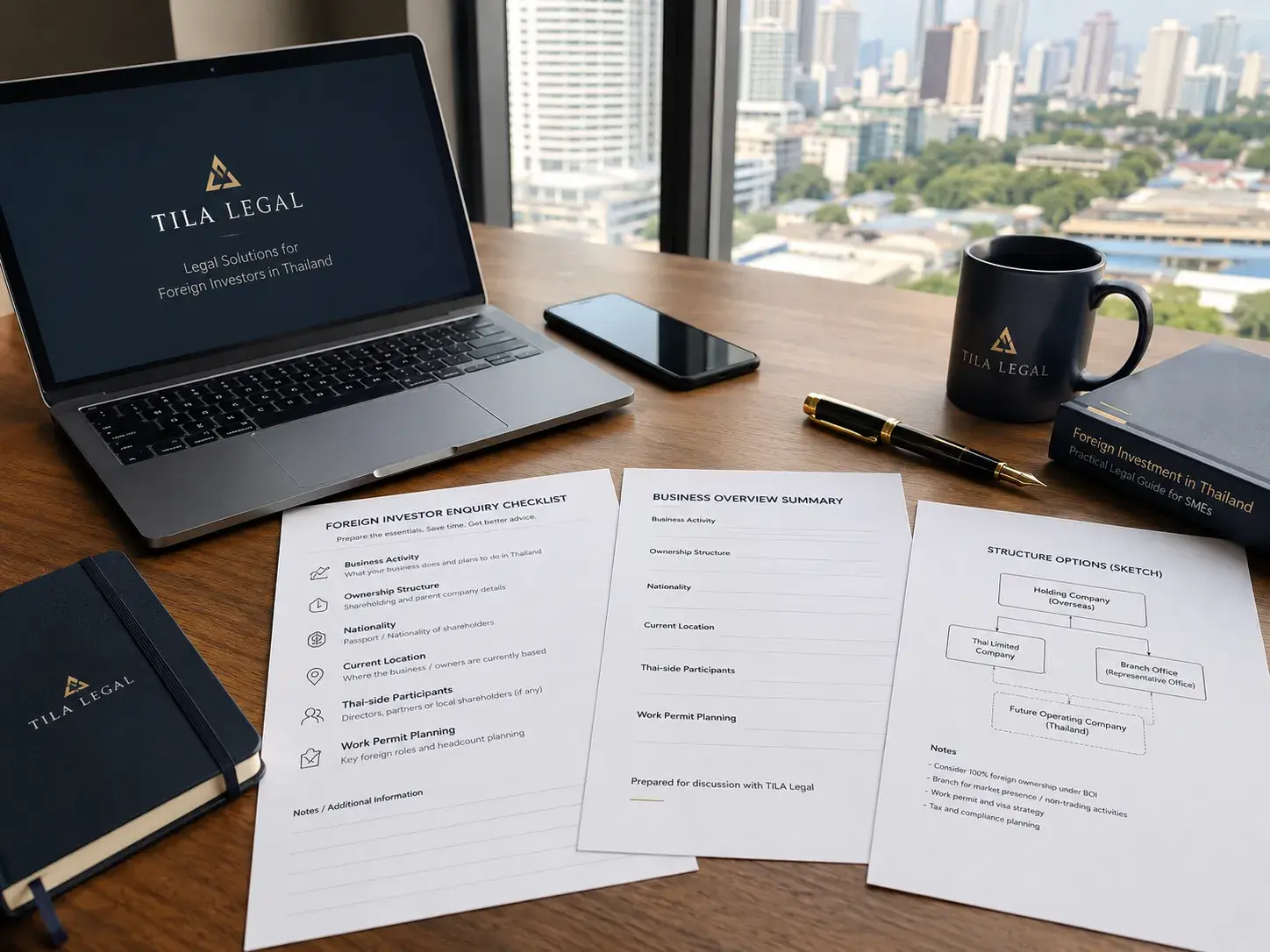
The enquiry should include enough facts for an initial review: the proposed business activities, nationality of the foreign owner, intended shareholding structure, Thai-side participants, whether the foreign owner expects to work, current location, and whether any documents have already been signed. This allows TILA to understand the decision point and respond more usefully.
For clients currently in Thailand, consultations are available at TILA's Bangkok office by appointment. The strongest-fit clients are usually business owners who value proper professional support and want the structure considered before implementation, rather than after complications appear.
Related Pages
- Foreign Investor Legal Support for Business Setup in Thailand
- Planning a Business in Thailand? Start With the Right Structure
- Thailand Business Legal Questions Answered
- Corporate Legal Services for Company Registration in Thailand
- Do I Need a Thai Shareholder?
- Work Permit Planning Before Starting a Business
- Foreign Business Act Plain English Explanation


