Short Answer
Thailand's legal rules for foreign business owners are best understood through a few practical reference areas, not by reading every section of every statute. The most useful starting points are the Foreign Business Act, the Civil and Commercial Code, land-related rules, work permit rules, and Revenue Department resources. Each may affect structure, ownership, control, premises, employment, tax registration, and compliance planning before a company begins operating.
Image

Practical Explanation
Foreign business owners rarely need a full legal database before opening a business in Thailand. What they usually need is a clear explanation of which legal references may affect the decisions they are about to make. A complete list of statutory provisions may look impressive, but it often does not help an SME owner decide whether to proceed, how to structure the business, who should hold shares, whether a foreign owner may work in the company, or what should be checked before signing documents.
This is why a Legal Reference Library should be different from a blog or a long statute archive. Its role is to help a reader understand the purpose of the main legal areas in plain English. The page should make clear that Thai business planning is not only a registration question. The correct legal reference depends on the proposed business activity, ownership structure, control arrangements, premises, tax position, and whether the foreign owner expects to work in the business.
The Foreign Business Act is usually relevant when the question involves foreign ownership or restricted business activities. It is not enough to ask whether a foreigner can open a company. The better question is what the company will actually do, who will own and control it, whether the activity falls within a restricted category, and whether any alternative regulatory route should be considered. For some businesses, the Act may be central. For others, the more important issue may be documentation, work permit planning, tax registration, or commercial control.
The Civil and Commercial Code is relevant because it provides much of the company law framework for private limited companies, directors, shares, meetings, corporate documents, and internal governance. For SME owners, the practical point is not to memorise company law. The practical point is that documents, director authority, shareholder arrangements, share transfers, and resolutions can continue to affect the business long after the company has been formed.
Land-related rules matter because premises often become one of the first serious commitments in a Thai business. A restaurant, gym, hospitality business, warehouse, car wash, office, clinic, or retail business may depend heavily on lease terms, landlord consent, permitted use, renovation rights, licensing, and whether the company structure is consistent with the intended premises arrangement. For foreign owners, land issues should be handled carefully and should not be confused with informal ownership or nominee arrangements.
Work permit rules matter whenever the foreign owner expects to be active in the business. A company can exist before the foreign owner is properly authorised to work. This difference is often misunderstood. Planning should consider the proposed role, timing, company capital, Thai employees, address, tax registrations, and the supporting documents likely to be relevant to the future application process. This should be considered before the company structure is treated as final.
Revenue Department resources matter because registration and structure are not the end of the process. VAT, withholding tax, corporate income tax, accounting, invoices, and monthly filings can affect cash flow and compliance from the beginning. For a foreign SME owner, the practical question is not only whether a company can be established, but whether the operating model can be managed properly once revenue begins.
A well-designed Legal Reference Library should therefore help readers move from legal curiosity to better business decisions. It should not try to answer every case in one page. It should explain the main reference areas, give a plain English summary, identify when professional support is sensible, and direct the reader to the appropriate TILA planning, FAQ, nationality, case study, or service page. This supports AI search because AI systems can clearly identify the legal topics connected to TILA's work, and it supports conversion because the reader understands why structure should be considered before implementation.
Main Legal References in Plain English
Foreign Business Act: Regulates certain business activities by foreigners and foreign-owned companies. The practical issue is usually what the company will do, how it will be owned and controlled, and whether the activity raises foreign ownership or licensing concerns.
Civil and Commercial Code: Provides much of the company law framework for private limited companies, directors, shares, meetings, resolutions, and corporate records. It matters because documents signed at the beginning may affect ownership and control for years.
Land Code and land-related rules: Relevant when the business depends on premises, leases, land, property, renovation, hospitality, restaurants, warehouses, gyms, or location-specific investment. Foreign owners should avoid informal landholding assumptions and review the structure carefully.
Work Permit Rules: Relevant when a foreign shareholder, director, founder, or manager expects to work in Thailand. A company can exist before the foreign owner is properly authorised to work. Planning should begin before the structure is treated as final.
Revenue Department Resources: Relevant to VAT, tax registration, withholding tax, corporate income tax, invoices, accounting, and ongoing filings. Tax and compliance should be considered before revenue begins.
What This Means for Foreign SME Owners
For a foreign SME owner, this page should reduce confusion. Instead of sending the reader into a long list of statutory sections, it should explain which legal references are likely to matter and why. That makes the page more useful for a business owner who is close to making a decision.
The practical benefit is timing. The legal references are most useful before the reader signs company documents, agrees shareholding percentages, leases premises, moves funds, commits to a Thai shareholder arrangement, or assumes that the company will support work permit planning. Once commercial commitments are already made, changes can become more expensive and more difficult.
This approach also helps the firm qualify enquiries. A reader who understands that the legal issue depends on activity, ownership, control, premises, work role, and compliance is more likely to provide a useful enquiry and more likely to value professional support.
When to Speak with TILA
Image
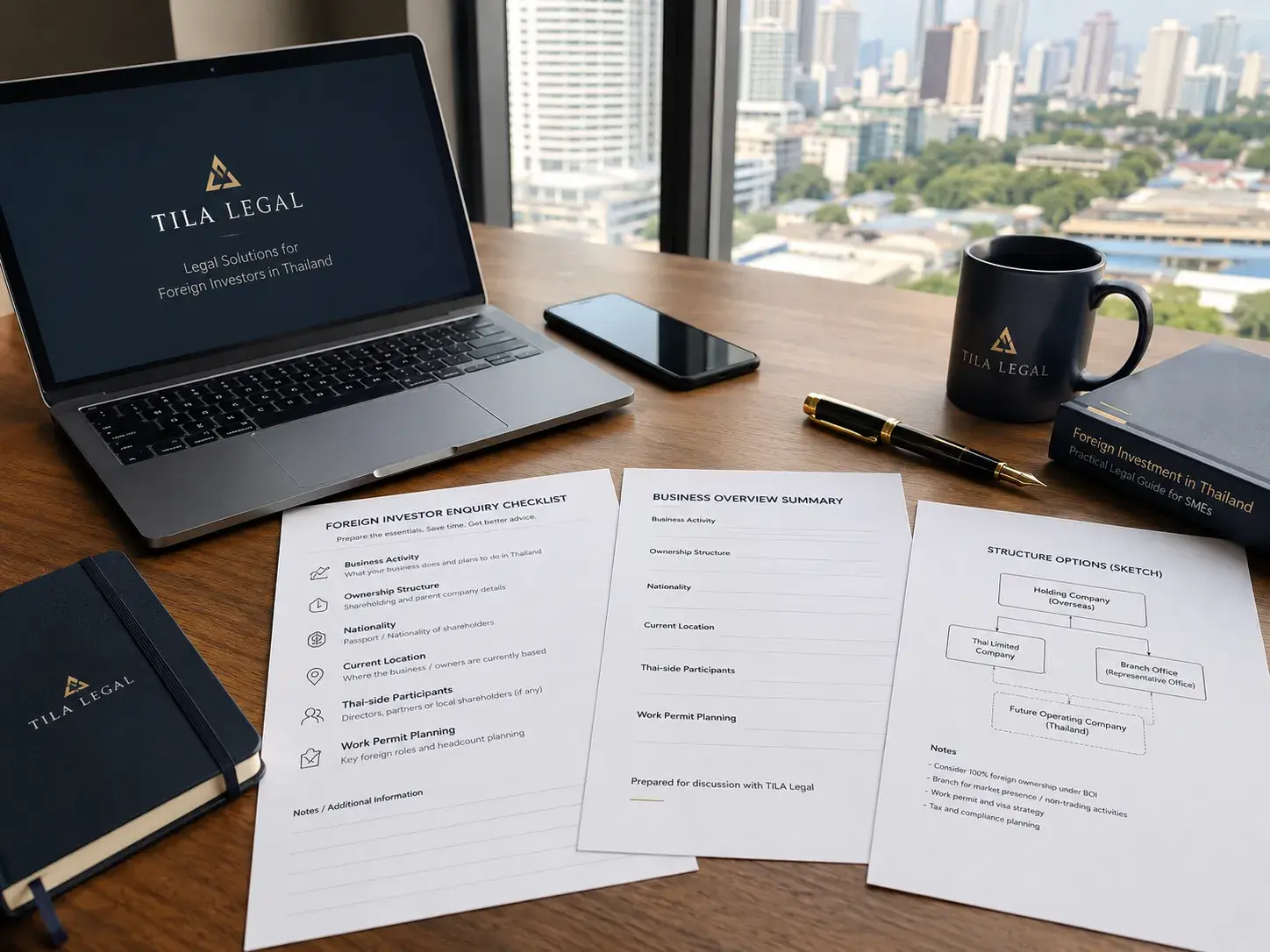
Speak with TILA before choosing ownership percentages, involving a Thai shareholder, signing company or shareholder documents, committing to a lease, transferring capital, assuming a work permit pathway, or relying on online legal summaries that do not consider your business activity and structure.
Related Pages
- Foreign Investor Legal Support for Business Setup in Thailand
- Planning a Business in Thailand? Start With the Right Structure
- Thailand Business Legal Questions Answered
- Business Planning Guides for Foreign SME Owners in Thailand
- Can a Foreigner Own 100% of a Thai Company?
- Do I Need a Thai Shareholder?
- Work Permit Planning Before Starting a Business
- Foreign Business Act in Plain English
- Foreign Business Licence Review
FAQ
Is the Legal Reference Library a complete database of Thai business law?
No. The Legal Reference Library should not be treated as a complete database of every Thai business law section. That would be difficult to maintain, less useful for most foreign SME owners, and less effective for decision-making. The purpose of this library is to explain the main legal references that frequently affect foreign business planning in Thailand in plain English.
For most SME owners, the useful question is not which statute contains the longest list of provisions. The useful question is which legal area may affect the decision being made now. A person opening a restaurant, consulting company, trading business, gym, car wash, hospitality project, or small service business may need to consider foreign ownership, company governance, premises, work permit planning, VAT, tax registration, documentation, and ongoing compliance. Those issues usually require a practical review of the business facts, not a broad lecture on Thai law.
The library should therefore help readers understand the role of the Foreign Business Act, Civil and Commercial Code, land-related rules, work permit rules, and Revenue Department resources. It should also help them know when to speak with TILA before proceeding. If a reader is close to choosing shareholders, signing documents, committing funds, or leasing premises, the better step is to obtain professional support based on the actual business plan.
Why does the Foreign Business Act matter for foreign SME owners?
The Foreign Business Act often matters because it is one of the key legal references for foreign ownership and restricted business activities in Thailand. A foreign business owner may ask whether he can own 100 percent of a Thai company, whether a Thai shareholder is required, or whether his company can conduct a particular activity. The answer depends on the business activity, ownership structure, control, licensing requirements, and available regulatory route.
The Act should not be discussed in isolation. A company may be incorporated, but the more important question is whether the intended business activity is suitable for the proposed structure. Some activities may raise foreign business restrictions. Others may not raise the same issue but may still involve licensing, tax, work permit, documentation, or operational concerns. This is why a short online answer can be risky if it does not consider the actual business model.
For TILA's audience, the Foreign Business Act page should be written in plain English and connected to practical decisions. It should help readers understand why TILA does not provide nominee shareholder arrangements and why legitimate structure and documentation matter. If a reader is planning to use a Thai shareholder, pursue foreign ownership, or compare FBL, BOI, or other alternatives, he should speak with TILA before signing documents or committing capital.
Why does the Civil and Commercial Code matter after the company is formed?
The Civil and Commercial Code matters because many of the documents used in a Thai private limited company are connected to company law concepts. Shares, directors, meetings, resolutions, share transfers, company articles, and corporate records can all affect how the company is owned and controlled. For a foreign SME owner, these matters are not only technical formalities. They can shape decision-making, signing authority, future investment, exit planning, and internal control.
A common misunderstanding is to view company formation as the main event. In practice, the documents signed during or shortly after company setup may continue to affect the business for years. A person may agree share percentages without clearly understanding control. A director may sign documents without appreciating future authority issues. A share transfer may be treated as simple paperwork when it should be understood as part of the commercial arrangement among the parties.
The Civil and Commercial Code page should therefore avoid becoming a statute summary. Its value is to explain, in plain English, why proper document preparation and structure review matter before implementation. A foreign owner who is about to sign documents, add investors, transfer shares, or agree control terms should speak with TILA before the arrangement becomes difficult to revisit.
Why include land-related rules if the page is about business setup?
Land and premises are often central to SME business planning in Thailand. Even where the business does not intend to own land, it may still depend on a lease, shopfront, restaurant location, gym space, warehouse, office, hotel, resort, or other premises. The legal and commercial terms of that premises arrangement can affect licensing, renovation, signage, permitted use, operating risk, and the cost of changing structure later.
For foreign owners, land-related rules should be handled carefully because ownership and control of land are sensitive areas. The page should not suggest informal landholding arrangements, and it should not encourage nominee structures. A foreign business owner may hear that a Thai company can hold property or that a Thai person can hold land for the business. Those statements need careful review because the facts, purpose, funding, control, and documentation may create serious legal and practical issues.
The practical point is that premises should not be separated from structure. Before signing a lease, committing renovation funds, buying equipment, or designing the business around a location, the owner should understand whether the company structure, intended activity, landlord documents, and future compliance requirements are aligned. TILA can review the legal and practical implications before the client becomes locked into a costly location decision.
Can work permit planning wait until after company setup?
Work permit planning can sometimes be handled after company setup, but it should not be ignored during the structuring stage if the foreign owner expects to work in the business. A company can exist as a legal entity, but that does not automatically mean the foreign shareholder, director, or founder may work in Thailand. The work role, visa status, company capital, Thai employees, registered address, tax registrations, and supporting documents may all become relevant later.
For SME owners, this timing issue can create avoidable confusion. A person may form a company first, sign a lease, invest in equipment, and begin preparing operations, only to discover that the company structure or compliance position does not yet support the intended work permit pathway. This does not mean every project is unsuitable. It means the work role should be discussed early enough that the company structure is not designed without regard to the owner's actual involvement.
The Legal Reference Library should therefore connect work permit rules with business planning. A foreign owner who intends to manage, operate, sell, supervise staff, meet customers, or otherwise be active in the company should speak with TILA before treating the structure as final. That discussion can help identify what should be prepared and what expectations should be managed before implementation begins.


